GV

GeezerVison

The World Wide Web, restored to 800 pixels of glory.

Home|About|Gaming cabinet|Archives|How it works|Starter sites

On this site

  • CODESCRACKER
  • Python
  • Java
  • C++
  • JavaScript
  • SQL
  • Quiz
  • C
  • C#
  • HTML
  • CSS
  • PHP
  • Networking
  • Operating System

This view

  • Original page
  • New address

GeezerVison is showing codescracker.com — Python repr() function

  • Python Built-in Functions
  • Python All Built-in Functions
  • Python print() Function
  • Python input() Function
  • Python int() Function
  • Python float() Function
  • Python len() Function
  • Python range() Function
  • Python str() Function
  • Python ord() Function
  • Python chr() Function
  • Python ascii() Function
  • Python pow() Function
  • Python type() Function
  • Python List Functions
  • Python list() Function
  • Python insert() Function
  • Python append() Function
  • Python extend() Function
  • Python pop() Function
  • Python remove() Function
  • Python reverse() Function
  • Python sort() Function
  • Python sorted() Function
  • Python Dictionary Functions
  • Python dict() Function
  • Python update() Function
  • Python get() Function
  • Python keys() Function
  • Python setdefault() Function
  • Python fromkeys() Function
  • Python items() Function
  • Python popitem() Function
  • Python Tuple Function
  • Python tuple() Function
  • Python Set Functions
  • Python set() Function
  • Python frozenset() Function
  • Python String Functions
  • Python split() Function
  • Python join() Function
  • Python format() Function
  • Python replace() Function
  • Python Iterator Functions
  • Python iter() Function
  • Python min() Function
  • Python max() Function
  • Python sum() Function
  • Python count() Function
  • Python index() Function
  • Python copy() Function
  • Python clear() Function
  • Python next() Function
  • Python filter() Function
  • Python enumerate() Function
  • Python zip() Function
  • Python reversed() Function
  • Python Number Functions
  • Python abs() Function
  • Python bin() Function
  • Python oct() Function
  • Python hex() Function
  • Python round() Function
  • Python divmod() Function
  • Python complex() Function
  • Python File Handling Functions
  • Python open() Function
  • Python read() Function
  • Python readable() Function
  • Python readline() Function
  • Python readlines() Function
  • Python write() Function
  • Python writable() Function
  • Python writelines() Function
  • Python close() Function
  • Python seek() Function
  • Python tell() Function
  • Python flush() Function
  • Python fileno() Function
  • Python truncate() Function
  • Python Class Functions
  • Python object() Function
  • Python property() Function
  • Python getattr() Function
  • Python setattr() Function
  • Python hasattr() Function
  • Python delattr() Function
  • Python classmethod() Function
  • Python staticmethod() Function
  • Python issubclass() Function
  • Python super() Function
  • Python Misc Functions
  • Python all() Function
  • Python any() Function
  • Python isatty() Function
  • Python bool() Function
  • Python callable() Function
  • Python globals() Function
  • Python locals() Function
  • Python dir() Function
  • Python id() Function
  • Python isinstance() Function
  • Python map() Function
  • Python repr() Function
  • Python slice() Function
  • Python vars() Function
  • Python Advance Functions
  • Python help() Function
  • Python hash() Function
  • Python breakpoint() Function
  • Python bytes() Function
  • Python bytearray() Function
  • Python memoryview() Function
  • Python compile() Function
  • Python eval() Function
  • Python exec() Function
  • Python Tutorial
  • Python Tutorial
  • Python Examples
  • Python Examples

Python repr() function

The repr() function in Python returns the canonical string representation of an object. For example:

x = 'Python Programming'
print(repr(x))
x = [1, 2, 34, 43]
print(repr(x))

The output will be:

'Python Programming'
[1, 2, 34, 43]

Python repr() function syntax

The syntax of the repr() function in Python is:

repr(object)

The repr() function basically returns the printable representation of an object.

Note: For many types of objects, including the most built-ins, eval(repr(obj)) gives obj.

Python repr() function example

Here is an example of the repr() function in Python:

print("Enter the string: ", end="")
str = input()

print("\n----The string is, without repr(str)----")
print(str)
print("\n----The string is, with repr(str)----")
print(repr(str))

The snapshot given below shows the sample run of the above program, with user input codes cracker dot com as a string:
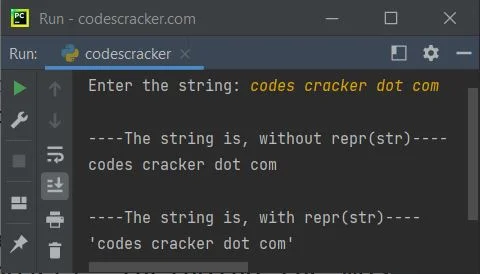
python repr function

Note: The repr() method is used to print the official representation of an object.

Advantages of the repr() function in Python

  • Gives you a string representation of an object that you can use to recreate it later.
  • The repr() function represents an object in a clear and unambiguous manner, making it useful for debugging and testing.
  • Some built-in Python functions, such as eval(), use it to recreate objects.

Disadvantages of the repr() function in Python

  • The string representation returned by repr() is not always user-friendly and may contain a lot of technical detail that the user is not interested in.
  • The string representation returned by repr() can be difficult to read and understand if the object being represented is large or complex.
  • Some Python objects may lack a meaningful repr() representation or may have a repr() representation that is unsuitable for use in recreating the object.

Python Online Test


« Previous Function Next Function »
Practice Quizzes

Test your programming and computer science knowledge with interactive MCQs and topic-based quizzes.

All Quizzes SQL Quiz Python Quiz Java Quiz C++ Quiz
Popular Topics

Explore the most popular programming and computer science tutorials on CodesCracker.

Python Tutorial Java Tutorial C++ Tutorial SQL Tutorial JavaScript Tutorial HTML Tutorial CSS Tutorial Computer Networking
You are visitor 01402503 — GeezerVison does not store the pages you look up.
Best viewed with Netscape Navigator 4.7 or Internet Explorer 6 at 800×600. No cookies required.