GeezerVisonThe World Wide Web, restored to 800 pixels of glory. |
| Home|About|Gaming cabinet|Archives|How it works|Starter sites |
GeezerVison is showing www.tutorialspoint.com — Design Patterns - Interpreter Pattern 
Creational Design Patterns
Structural Design Patterns
Behavioral Design Patterns
J2EE Design Patterns
Design Patterns Useful Resources
Selected Reading
Design Patterns - Interpreter PatternInterpreter pattern provides a way to evaluate language grammar or expression. This type of pattern comes under behavioral pattern. This pattern involves implementing an expression interface which tells to interpret a particular context. This pattern is used in SQL parsing, symbol processing engine etc. ImplementationWe are going to create an interface Expression and concrete classes implementing the Expression interface. A class TerminalExpression is defined which acts as a main interpreter of context in question. Other classes OrExpression, AndExpression are used to create combinational expressions. InterpreterPatternDemo, our demo class, will use Expression class to create rules and demonstrate parsing of expressions. 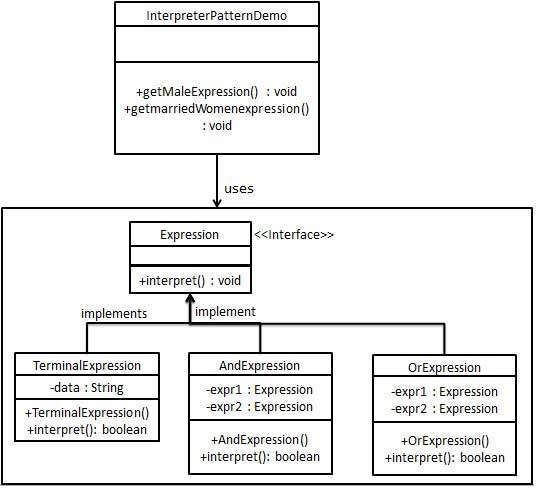
Step 1Create an expression interface. Expression.javapackage com.tutorialspoint;
public interface Expression {
public boolean interpret(String context);
}
Step 2Create concrete classes implementing the above interface. TerminalExpression.javapackage com.tutorialspoint;
public class TerminalExpression implements Expression {
private String data;
public TerminalExpression(String data){
this.data = data;
}
@Override
public boolean interpret(String context) {
if(context.contains(data)){
return true;
}
return false;
}
}
OrExpression.javapackage com.tutorialspoint;
public class OrExpression implements Expression {
private Expression expr1 = null;
private Expression expr2 = null;
public OrExpression(Expression expr1, Expression expr2) {
this.expr1 = expr1;
this.expr2 = expr2;
}
@Override
public boolean interpret(String context) {
return expr1.interpret(context) || expr2.interpret(context);
}
}
AndExpression.javapackage com.tutorialspoint;
public class AndExpression implements Expression {
private Expression expr1 = null;
private Expression expr2 = null;
public AndExpression(Expression expr1, Expression expr2) {
this.expr1 = expr1;
this.expr2 = expr2;
}
@Override
public boolean interpret(String context) {
return expr1.interpret(context) && expr2.interpret(context);
}
}
Example - Usage of Interpreter PatternInterpreterPatternDemo uses Expression class to create rules and then parse them. InterpreterPatternDemo.javapackage com.tutorialspoint;
public class InterpreterPatternDemo {
//Rule: Robert and John are male
public static Expression getMaleExpression(){
Expression robert = new TerminalExpression("Robert");
Expression john = new TerminalExpression("John");
return new OrExpression(robert, john);
}
//Rule: Julie is a married women
public static Expression getMarriedWomanExpression(){
Expression julie = new TerminalExpression("Julie");
Expression married = new TerminalExpression("Married");
return new AndExpression(julie, married);
}
public static void main(String[] args) {
Expression isMale = getMaleExpression();
Expression isMarriedWoman = getMarriedWomanExpression();
System.out.println("John is male? " + isMale.interpret("John"));
System.out.println("Julie is a married women? " + isMarriedWoman.interpret("Married Julie"));
}
}
interface Expression {
public boolean interpret(String context);
}
class TerminalExpression implements Expression {
private String data;
public TerminalExpression(String data){
this.data = data;
}
@Override
public boolean interpret(String context) {
if(context.contains(data)){
return true;
}
return false;
}
}
class OrExpression implements Expression {
private Expression expr1 = null;
private Expression expr2 = null;
public OrExpression(Expression expr1, Expression expr2) {
this.expr1 = expr1;
this.expr2 = expr2;
}
@Override
public boolean interpret(String context) {
return expr1.interpret(context) || expr2.interpret(context);
}
}
class AndExpression implements Expression {
private Expression expr1 = null;
private Expression expr2 = null;
public AndExpression(Expression expr1, Expression expr2) {
this.expr1 = expr1;
this.expr2 = expr2;
}
@Override
public boolean interpret(String context) {
return expr1.interpret(context) && expr2.interpret(context);
}
}
OutputVerify the output. John is male? true Julie is a married women? true 
Advertisements
|
| You are visitor 01402775 — GeezerVison does not store the pages you look up. Best viewed with Netscape Navigator 4.7 or Internet Explorer 6 at 800×600. No cookies required. |