GeezerVisonThe World Wide Web, restored to 800 pixels of glory. |
| Home|About|Gaming cabinet|Archives|How it works|Starter sites |
GeezerVison is showing www.tutorialspoint.com — Design Patterns - Strategy Pattern 
Creational Design Patterns
Structural Design Patterns
Behavioral Design Patterns
J2EE Design Patterns
Design Patterns Useful Resources
Selected Reading
Design Patterns - Strategy PatternOverviewIn Strategy pattern, a class behavior or its algorithm can be changed at run time. This type of design pattern comes under behavior pattern. In Strategy pattern, we create objects which represent various strategies and a context object whose behavior varies as per its strategy object. The strategy object changes the executing algorithm of the context object. ImplementationWe are going to create a Strategy interface defining an action and concrete strategy classes implementing the Strategy interface. Context is a class which uses a Strategy. StrategyPatternDemo, our demo class, will use Context and strategy objects to demonstrate change in Context behaviour based on strategy it deploys or uses. 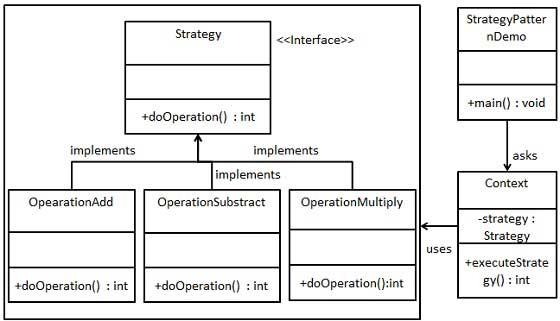
Step 1Create an interface. Strategy.javapackage com.tutorialspoint;
public interface Strategy {
public int doOperation(int num1, int num2);
}
Step 2Create concrete classes implementing the same interface. OperationAdd.javapackage com.tutorialspoint;
public class OperationAdd implements Strategy{
@Override
public int doOperation(int num1, int num2) {
return num1 + num2;
}
}
OperationSubstract.javapackage com.tutorialspoint;
public class OperationSubstract implements Strategy{
@Override
public int doOperation(int num1, int num2) {
return num1 - num2;
}
}
OperationMultiply.javapackage com.tutorialspoint;
public class OperationMultiply implements Strategy{
@Override
public int doOperation(int num1, int num2) {
return num1 * num2;
}
}
Step 3Create Context Class. Context.javapackage com.tutorialspoint;
public class Context {
private Strategy strategy;
public Context(Strategy strategy){
this.strategy = strategy;
}
public int executeStrategy(int num1, int num2){
return strategy.doOperation(num1, num2);
}
}
Example - Usage of Strategy PatternUse the Context to see change in behaviour when it changes its Strategy. StrategyPatternDemo.javapackage com.tutorialspoint;
public class StrategyPatternDemo {
public static void main(String[] args) {
Context context = new Context(new OperationAdd());
System.out.println("10 + 5 = " + context.executeStrategy(10, 5));
context = new Context(new OperationSubstract());
System.out.println("10 - 5 = " + context.executeStrategy(10, 5));
context = new Context(new OperationMultiply());
System.out.println("10 * 5 = " + context.executeStrategy(10, 5));
}
}
interface Strategy {
public int doOperation(int num1, int num2);
}
class OperationAdd implements Strategy{
@Override
public int doOperation(int num1, int num2) {
return num1 + num2;
}
}
class OperationSubstract implements Strategy{
@Override
public int doOperation(int num1, int num2) {
return num1 - num2;
}
}
class OperationMultiply implements Strategy{
@Override
public int doOperation(int num1, int num2) {
return num1 * num2;
}
}
class Context {
private Strategy strategy;
public Context(Strategy strategy){
this.strategy = strategy;
}
public int executeStrategy(int num1, int num2){
return strategy.doOperation(num1, num2);
}
}
OutputVerify the output. 10 + 5 = 15 10 - 5 = 5 10 * 5 = 50 
Advertisements
|
| You are visitor 01402775 — GeezerVison does not store the pages you look up. Best viewed with Netscape Navigator 4.7 or Internet Explorer 6 at 800×600. No cookies required. |