GeezerVisonThe World Wide Web, restored to 800 pixels of glory. |
| Home|About|Gaming cabinet|Archives|How it works|Starter sites |
GeezerVison is showing www.tutorialspoint.com — Design Patterns - State Pattern 
Creational Design Patterns
Structural Design Patterns
Behavioral Design Patterns
J2EE Design Patterns
Design Patterns Useful Resources
Selected Reading
Design Patterns - State PatternIn State pattern a class behavior changes based on its state. This type of design pattern comes under behavior pattern. In State pattern, we create objects which represent various states and a context object whose behavior varies as its state object changes. ImplementationWe are going to create a State interface defining an action and concrete state classes implementing the State interface. Context is a class which carries a State. StatePatternDemo, our demo class, will use Context and state objects to demonstrate change in Context behavior based on type of state it is in. 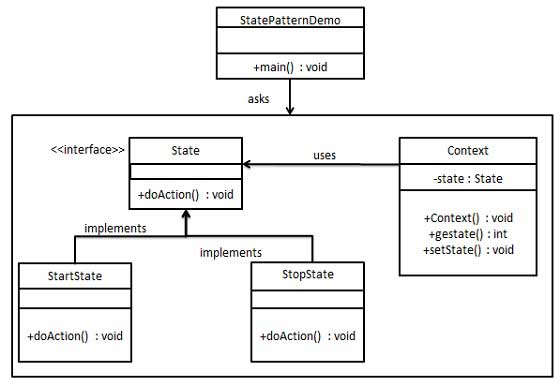
Step 1Create an interface. State.javapackage com.tutorialspoint;
public interface State {
public void doAction(Context context);
}
Step 2Create concrete classes implementing the same interface. StartState.javapackage com.tutorialspoint;
public class StartState implements State {
public void doAction(Context context) {
System.out.println("Player is in start state");
context.setState(this);
}
public String toString(){
return "Start State";
}
}
StopState.javapackage com.tutorialspoint;
public class StopState implements State {
public void doAction(Context context) {
System.out.println("Player is in stop state");
context.setState(this);
}
public String toString(){
return "Stop State";
}
}
Step 3Create Context Class. Context.javapackage com.tutorialspoint;
public class Context {
private State state;
public Context(){
state = null;
}
public void setState(State state){
this.state = state;
}
public State getState(){
return state;
}
}
Example - Usage of State PatternUse the Context to see change in behaviour when State changes. StatePatternDemo.javapackage com.tutorialspoint;
public class StatePatternDemo {
public static void main(String[] args) {
Context context = new Context();
StartState startState = new StartState();
startState.doAction(context);
System.out.println(context.getState().toString());
StopState stopState = new StopState();
stopState.doAction(context);
System.out.println(context.getState().toString());
}
}
interface State {
public void doAction(Context context);
}
class StartState implements State {
public void doAction(Context context) {
System.out.println("Player is in start state");
context.setState(this);
}
public String toString(){
return "Start State";
}
}
class StopState implements State {
public void doAction(Context context) {
System.out.println("Player is in stop state");
context.setState(this);
}
public String toString(){
return "Stop State";
}
}
class Context {
private State state;
public Context(){
state = null;
}
public void setState(State state){
this.state = state;
}
public State getState(){
return state;
}
}
OutputVerify the output. Player is in start state Start State Player is in stop state Stop State 
Advertisements
|
| You are visitor 01402775 — GeezerVison does not store the pages you look up. Best viewed with Netscape Navigator 4.7 or Internet Explorer 6 at 800×600. No cookies required. |