GeezerVisonThe World Wide Web, restored to 800 pixels of glory. |
| Home|About|Gaming cabinet|Archives|How it works|Starter sites |
GeezerVison is showing explorable.com — Population Sampling - Representative Subset of a Population 
Population Sampling TechniquesExplorable.com Population sampling is the process of taking a subset of subjects that is representative of the entire population. The sample must have sufficient size to warrant statistical analysis. This article is a part of the guide:Discover 23 more articles on this topic Don't miss these related articles: Browse Full OutlineSampling is done usually because it is impossible to test every single individual in the population. It is also done to save time, money and effort while conducting the research. Still, every researcher must keep in mind that the ideal scenario is to test all the individuals to obtain reliable, valid and accurate results. If testing all the individuals is impossible, that is the only time we rely on sampling techniques. Performing population sampling must be conducted correctly since errors can lead to inaccurate and misleading data. Types of SamplingNon-Probability SamplingIn this type of population sampling, members of the population do not have equal chance of being selected. Due to this, it is not safe to assume that the sample fully represents the target population. It is also possible that the researcher deliberately chose the individuals that will participate in the study. Non-probability population sampling method is useful for pilot studies, case studies, qualitative research, and for hypothesis development. This sampling method is usually employed in studies that are not interested in the parameters of the entire population. Some researchers prefer this sampling technique because it is cheap, quick and easy. Probability SamplingIn probability sampling, every individual in the population have equal chance of being selected as a subject for the research. This method guarantees that the selection process is completely randomized and without bias. The most basic example of probability sampling is listing all the names of the individuals in the population in separate pieces of paper, and then drawing a number of papers one by one from the complete collection of names. The advantage of using probability sampling is the accuracy of the statistical methods after the experiment. It can also be used to estimate the population parameters since it is representative of the entire population. It is also a reliable method to eliminate sampling bias. Steps in Recruiting the Appropriate Research Sample
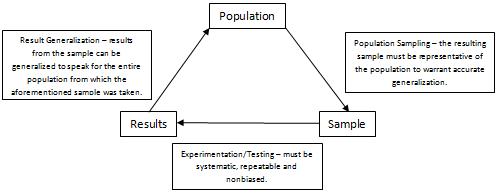
Research Triad
Result GeneralizationResults from the sample can be generalized to speak for the entire population from which the aforementioned sample was taken. Population SamplingThe resulting sample must be representative of the population to warrant accurate generalization. Experimentation/testingShould be systematic, repeatable and nonbiased. Full reference: Explorable.com (Jul 21, 2009). Population Sampling Techniques. Retrieved Oct 28, 2026 from Explorable.com: https://explorable.com/population-sampling You Are Allowed To Copy The TextThe text in this article is licensed under the Creative Commons-License Attribution 4.0 International (CC BY 4.0). This means you're free to copy, share and adapt any parts (or all) of the text in the article, as long as you give appropriate credit and provide a link/reference to this page. That is it. You don't need our permission to copy the article; just include a link/reference back to this page. You can use it freely (with some kind of link), and we're also okay with people reprinting in publications like books, blogs, newsletters, course-material, papers, wikipedia and presentations (with clear attribution). This article is a part of the guide:Discover 23 more articles on this topic Don't miss these related articles: Browse Full OutlineThank you to... This project has received funding from the European Union's Horizon 2020 research and innovation programme under grant agreement No 827736.
 Explorable.com - 2008-2026 You are free to copy, share and adapt any text in the article, as long as you give appropriate credit and provide a link/reference to this page. This website uses cookiesThis website uses cookies. By agreeing you consent to all cookies on this website in accordance with our Cookie Policy. Read more |
| You are visitor 01402503 — GeezerVison does not store the pages you look up. Best viewed with Netscape Navigator 4.7 or Internet Explorer 6 at 800×600. No cookies required. |