GeezerVisonThe World Wide Web, restored to 800 pixels of glory. |
| Home|About|Gaming cabinet|Archives|How it works|Starter sites |
GeezerVison is showing explorable.com — Sampling Error in Research - Sampling Bias 
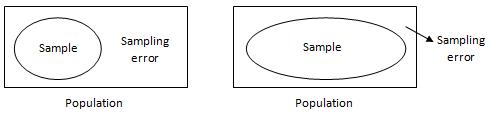
Sampling ErrorExplorable.com Sampling error is the deviation of the selected sample from the true characteristics, traits, behaviors, qualities or figures of the entire population. This article is a part of the guide:Discover 23 more articles on this topic Don't miss these related articles: Browse Full OutlineWhy Does This Error Occur?Sampling process error occurs because researchers draw different subjects from the same population but still, the subjects have individual differences. Keep in mind that when you take a sample, it is only a subset of the entire population; therefore, there may be a difference between the sample and population. The most frequent cause of the said error is a biased sampling procedure. Every researcher must seek to establish a sample that is free from bias and is representative of the entire population. In this case, the researcher is able to minimize or eliminate sampling error. Another possible cause of this error is chance. The process of randomization and probability sampling is done to minimize sampling process error but it is still possible that all the randomized subjects are not representative of the population. The most common result of sampling error is systematic error wherein the results from the sample differ significantly from the results from the entire population. It follows logic that if the sample is not representative of the entire population, the results from it will most likely differ from the results taken from the entire population. Sample Size and Sampling ErrorGiven two exactly the same studies, same sampling methods, same population, the study with a larger sample size will have less sampling process error compared to the study with smaller sample size. Keep in mind that as the sample size increases, it approaches the size of the entire population, therefore, it also approaches all the characteristics of the population, thus, decreasing sampling process error.
Standard Deviation and Sampling ErrorStandard deviation is used to express the variability of the population. More technically, it is the average difference of all the actual scores of the subjects from the mean or average of all the scores. Therefore, if the sample has high standard deviation, it follows that sample also has high sampling process error. It will be easier to understand this if you will relate standard deviation with sample size. Keep in mind that as the sample size increases, the standard deviation decreases. Imagine having only 10 subjects, with this very little sample size, the tendency of their results is to vary greatly, thus a high standard deviation. Then, imagine increasing the sample size to 100, the tendency of their scores is to cluster, thus a low standard deviation. Ways to Eliminate Sampling ErrorThere is only one way to eliminate this error. This solution is to eliminate the concept of sample, and to test the entire population. In most cases this is not possible; consequently, what a researcher must to do is to minimize sampling process error. This can be achieved by a proper and unbiased probability sampling and by using a large sample size. Full reference: Explorable.com (Jan 7, 2009). Sampling Error. Retrieved Oct 28, 2026 from Explorable.com: https://explorable.com/sampling-error You Are Allowed To Copy The TextThe text in this article is licensed under the Creative Commons-License Attribution 4.0 International (CC BY 4.0). This means you're free to copy, share and adapt any parts (or all) of the text in the article, as long as you give appropriate credit and provide a link/reference to this page. That is it. You don't need our permission to copy the article; just include a link/reference back to this page. You can use it freely (with some kind of link), and we're also okay with people reprinting in publications like books, blogs, newsletters, course-material, papers, wikipedia and presentations (with clear attribution). This article is a part of the guide:Discover 23 more articles on this topic Don't miss these related articles: Browse Full OutlineThank you to... This project has received funding from the European Union's Horizon 2020 research and innovation programme under grant agreement No 827736.
 Explorable.com - 2008-2026 You are free to copy, share and adapt any text in the article, as long as you give appropriate credit and provide a link/reference to this page. This website uses cookiesThis website uses cookies. By agreeing you consent to all cookies on this website in accordance with our Cookie Policy. Read more |
| You are visitor 01402503 — GeezerVison does not store the pages you look up. Best viewed with Netscape Navigator 4.7 or Internet Explorer 6 at 800×600. No cookies required. |