GV

GeezerVison

The World Wide Web, restored to 800 pixels of glory.

Home|About|Gaming cabinet|Archives|How it works|Starter sites

On this site

  • Introduction
  • Hardware
  • Software
  • Sound Quality
  • Reference
  • Enjoy
  • AccurateRip
  • Acoustid
  • AES/EBU
  • AirPlay
  • Amplifier
  • aptX
  • Audio file formats
  • AAC

This view

  • Original page
  • New address

GeezerVison is showing thewelltemperedcomputer.com — The Well-Tempered Computer

The Well-Tempered Computer

An introduction to computer audio

  • Introduction
  • Hardware
  • Software
  • Sound Quality
  • Reference
  • Enjoy
  • AccurateRip
  • Acoustid
  • AES/EBU
  • AirPlay
  • Amplifier
  • aptX
  • Audio file formats
    • AAC
    • AIFF
    • ALAC
    • APE
    • DSD
    • DXD
    • FLAC
    • MP3
    • MQA
    • M4A
    • WAV
    • WMAL
  • ASRC
  • AVB
  • Bit perfect jitter
  • Bits: 16 or 24
  • Bit perfect playback
  • Bitrate
  • Bluetooth
  • Burn-in
  • BWF
  • Cables
    • Analog
    • Speaker
    • Bi-wiring
    • Digital
  • CDtext
  • Chromecast
  • Clipping
  • Clock
  • Codec
  • Compression
  • CRC
  • Crossover
  • Cue sheet
  • DAC
  • Damping
  • DASH
  • Digital
  • Digital Room Correction
  • Dither
  • DLNA
  • Drivers
    • ASIO
    • Direct Sound
    • Kernel Streaming
    • WASAPI
    • Wave Out
  • DoP
  • DSP
  • EBU R128 (loudness)
  • FFT
  • FireWire
  • Freedb
  • Gapless playback
  • Generation loss
  • HDMI
  • Headphone listening
  • Hearing
    • Single-sided deafness
    • Hard of hearing
  • Hires recording
  • Homeplug
  • I2S
  • ID3
  • Inter sample peak
  • LDAC
  • Linearity (DAC)
  • Memory playback
  • Music Server
  • OCF
  • OFC
  • PCM
  • Perception
  • RAID
  • ReplayGain
  • Ripping
  • RFI
  • RIAA
  • Router
  • Sampling, up and over
  • Sample Rate Conversion
  • Speakers
    • Driver design
    • Crossover
    • Amplification
    • Connecting
    • Measurement
    • Placement
  • S/PDIF
  • Storage
  • Sync
  • Tagging
  • Toslink
  • Transcoding
  • UAA
  • Units
  • UPnP
  • USB
  • VST
  • WiFi
  • WiSA

Fast Fourier Transform

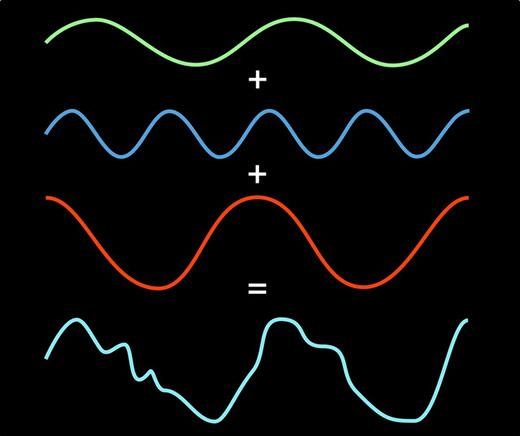
Audio is a complex signal.
It is a mix of different frequencies.
A Fourier Transform can decompose this signal in individual frequencies.
Likewise if you sum these individual frequencies you get the original sound.

The fast Fourier transform (FFT), is a computer algorithm that computes the discrete Fourier transform much faster than other algorithms


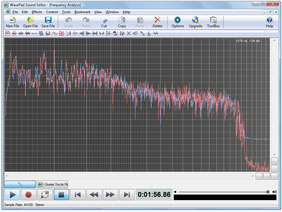
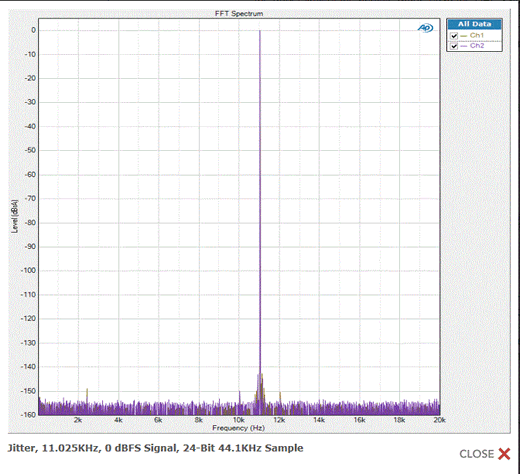
FFT graphs are used to display the frequency content of a small sample.

It displays the frequency content (Hz) and the intensity in dB.

You can analyze the performance of a DAC using FFT.

Send a 11 kHz test signal to the DAC and analyze the frequency content of the analog out.


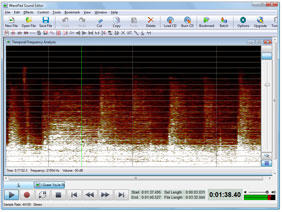
TFFT (Temporal Frequency Analysis) plots the frequencies over time.

A color intensity scale represents the intensity of the frequency.

Demo

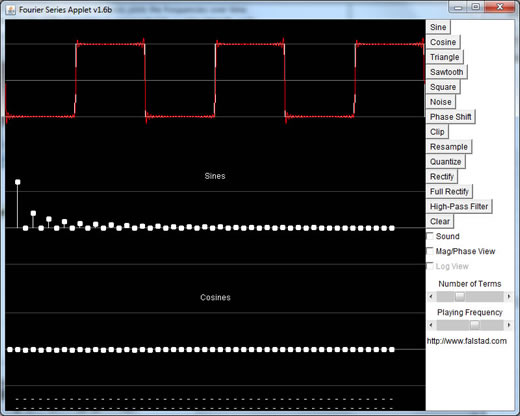
Paul Falstad wrote an applet demonstrating how very different functions like a triangle or a square can be generated from a sum of cosine terms.


References

  1. The Fundamentals of FFT-Based Audio Measurements in SmaartLive - Paul D. Henderson
  2. Fast Fourier transform - WikipediA
  3. WavePad FFT Sound Analyzer - NCH
  4. Mastering The Fourier Transform in One Day - Bernsee
  5. Fourier applet - Paul Falstad


© Vincent Kars January 2012


You are visitor 01402503 — GeezerVison does not store the pages you look up.
Best viewed with Netscape Navigator 4.7 or Internet Explorer 6 at 800×600. No cookies required.