GeezerVisonThe World Wide Web, restored to 800 pixels of glory. |
| Home|About|Gaming cabinet|Archives|How it works|Starter sites |
GeezerVison is showing thewelltemperedcomputer.com — The Well-Tempered Computer
Believing is hearingVisit a couple of audio forums and you will notice that there are as many opinions as forum members. Often very strong opinions, so strong you might call it a passion. Passion is our driving force it don’t improve our reality testing.
It might be interesting to read a primer about perception. These psychologists do all kind of very funny experiments. The control group is asked to rate this paper but you won't tell them anything about the author. Guess what, the experimental group rates this article significantly higher than the control group.
Sean Olive tested loudspeaker preferences using the same speakers in both a sighted and a unsighted test. The sighted tests produced a significant increase in preference ratings for the larger, more expensive loudspeakers
 The same effect could be observed when the speakers where positioned different. 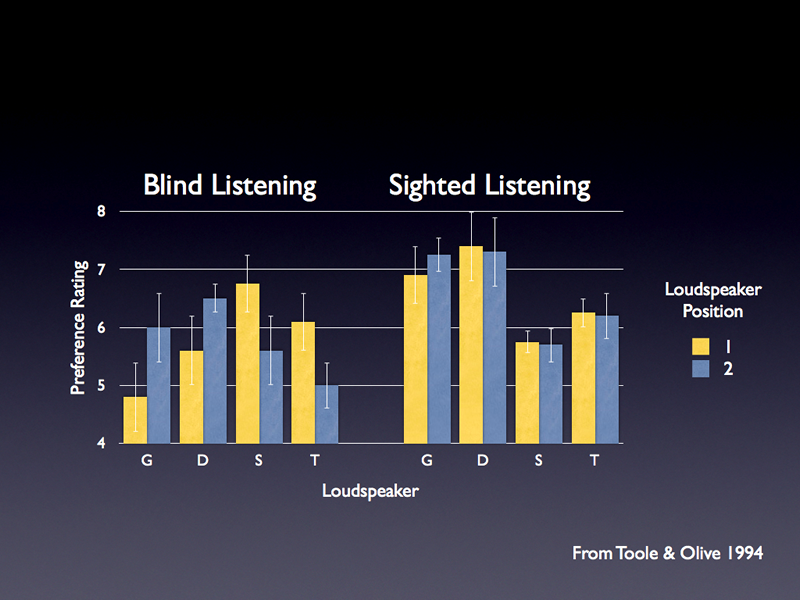
The best way to protect yourself against your own believes is to do an unsighted test. ABX You have bought a high-end power cord.
Your keep notes. After 16 trials, you compare notes. If you are above change level, you can hear the differences; you have made the right choice. If you are not, you know you better don't spend your money on another high-end power cord. You win anyway.
Like all unsighted testing, ABX test removes the bias of the listener. You have not proven that there is no difference. You have proven that you in your specific experimental setup are not able to discern between the two. A different setup or another person might yield different results.
A good example of a blind test in practice, comparing speaker cables. I admire the courage and the honesty of the poster, Mike Lavigne. People able to admit that they spend over $ 30.000 (thirty thousand) on a speaker wire for zero audible difference are rare.
More about ABX: http://www.hydrogenaudio.org/forums/index.php?showtopic=16295 MemoryEchoic memory is one of the sensory memory registers; a component of short-term memory (STM) that is specific to retaining auditory information. This particular sensory store is capable of storing large amounts of auditory information that is only retained for a short period of time (3-4 seconds). This echoic sound resonates in the mind and is replayed for this brief amount of time shortly after the presentation of auditory stimuli. ……. A short-term memory model proposed by Nelson Cowan attempts to address this problem by describing a verbal sensory memory input and storage in more detail. It suggests a pre-attentive sensory storage system that can hold a large amount of accurate information over a short period of time and consists of an initial phase input of 200-400ms and a secondary phase that transfers the information into a more long term memory store to be integrated into working memory that starts to decay after 10-20s.[5] Echoic memory – Wikipedia
If an ABX test shows a statistically significant difference then you can reasonably conclude that there is a difference. Unfortunately, a likely outcome will be that the test will not show a statistically significant difference. In that event it would be improper to conclude that there is no difference. You will be back where you started.
ABC/HRABC/Hidden Reference ( ITU-R BS.1116-1) is pretty much like ABX. It is a recommended method for testing for small differences between codecs and the original.
More: http://wiki.hydrogenaudio.org/index.php?title=ABC/HR MUSHRAMUlti Stimulus test with Hidden Reference and Anchors is recommended for audio quality assessment by EBU/ITU-R.
It is used to compare lossy codecs. More: http://www.ebu.ch/en/technical/trev/trev_283-kozamernik.pdf BS.1116This is method by the ITU for detecting small impairments in audio systems. It covers almost everuthing like
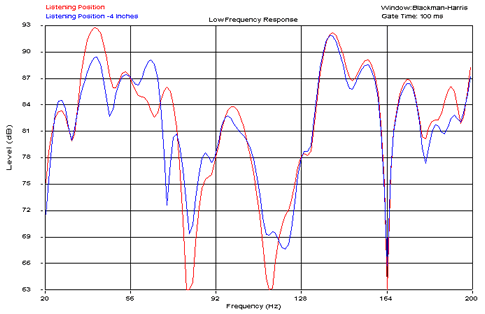
Experimental setup All these testing methods have one thing in common, removing the bias of the participant. They won’t prevent you against errors in your experimental setup. If Toslink is set to full range and USB to laptop speakers (Windows default), this is not a surprise. If you overlook these aspects you draw the wrong conclusion using the right method. More about the right conditions: Statistical Analysis of ABX Results Using Signal Detection Theory How long should you listen?Much to my surprise, sometimes very short. Tomasz, regarding memory-based testing and instant switching: Loudness matchingLoudness matching is very important when comparing products because the perception of timbre, spatial and dynamic attributes are level dependent. A lot of sales man knows this. Just turn up the volume a little when demonstrating the expensive one does wonders. Listening positionAn important aspect is your seating position. You listen to your system. You swap a speaker cable and start listening again. You do hear a difference. Your conclusion: you do hear differences between speaker cables. Another conclusion might be that you do hear a difference because your seating position has changed. In fact, a shift of just 4 inches makes a difference. Not an ‘audiophile’ difference but a measurable difference.
Frequency response at two locations four inches apart Ethan Winer: Why We Believe. A common-sense explanation of audiophile beliefs.
Me and my perceptionGot some music in a M4A format containing Apple Lossless. Then I found a player (MusiCHI) able to convert them to high bit rate MP3.
Sometime later I got the same M4A, this time not corrupted. Could not resist comparing a couple of tracks with their MP3 equivalent.
I tried a second set. Lesson learned (for the 1000’th time): trust your ears but don’t trust your perception. It will let you hear what you believe.
Reference
© Vincent Kars
June 7, 2023
|
| You are visitor 01402503 — GeezerVison does not store the pages you look up. Best viewed with Netscape Navigator 4.7 or Internet Explorer 6 at 800×600. No cookies required. |