GeezerVisonThe World Wide Web, restored to 800 pixels of glory. |
| Home|About|Gaming cabinet|Archives|How it works|Starter sites |
GeezerVison is showing codescracker.com — Python Program to Subtract Two Matrices
Python Program to Subtract Two MatricesThis article contains multiple programs in Python that performs matrix subtraction. Here are the list of programs covered by this article:
Subtract Two Matrices in PythonThe question is, write a Python program to perform matrix subtraction. The program given below is its answer: matrix1 = [[10, 11, 12],
[13, 14, 15],
[16, 17, 18]]
matrix2 = [[1, 2, 3],
[4, 5, 6],
[7, 8, 9]]
rmatrix = [[0, 0, 0],
[0, 0, 0],
[0, 0, 0]]
for i in range(len(matrix1)):
for j in range(len(matrix1[0])):
rmatrix[i][j] = matrix1[i][j] - matrix2[i][j]
for r in rmatrix:
print(r)
The output produced by above Python program is: [9, 9, 9] [9, 9, 9] [9, 9, 9] The subtraction of two matrices in above program can be calculated as:
Python Subtract Two Given 3*3 MatricesThe question is, write a Python program to subtract two matrices. Elements for both the matrix must be received by user at run-time of the program. Answer to this question, is the program given below: matOne = [] print("Enter 9 Elements for First Matrix: ") for i in range(3): matOne.append([]) for j in range(3): num = int(input()) matOne[i].append(num) matTwo = [] print("Enter 9 Elements for Second Matrix: ") for i in range(3): matTwo.append([]) for j in range(3): num = int(input()) matTwo[i].append(num) matThree = [] for i in range(3): matThree.append([]) for j in range(3): sub = matOne[i][j] - matTwo[i][j] matThree[i].append(sub) print("\nSubtraction Result of Two Given Matrices is:") for i in range(3): for j in range(3): print(matThree[i][j], end=" ") print() The snapshot given below shows the sample run of above python program with user input 2, 3, 4, 5, 6, 7, 8, 9, 10 as nine elements for first, whereas 0, 1, 2, 3, 4, 5, 6, 7, 8 as nine elements for second matrix: 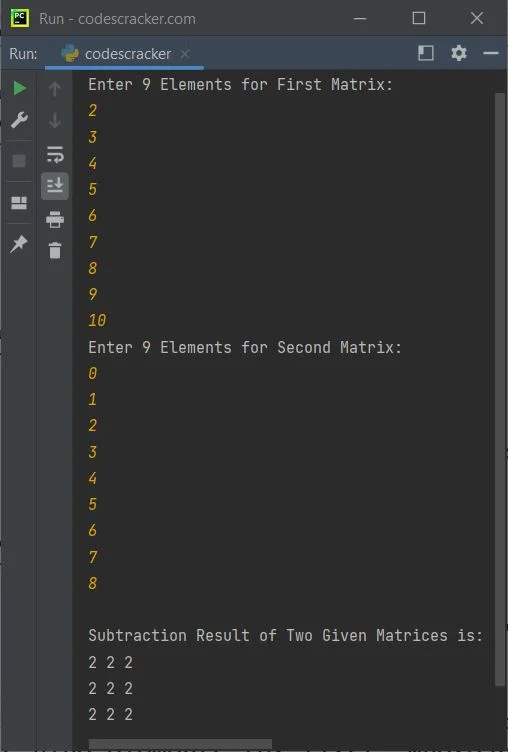
Python Subtract Two Given MatricesThis is the last program of this article, created to allow user to define the order and elements for both the matrices. print("Enter the Row and Column Size of First Matrix: ", end="") rowOne = int(input()) colOne = int(input()) print("Enter the Row and Column Size of Second Matrix: ", end="") rowTwo = int(input()) colTwo = int(input()) if rowOne==rowTwo and colOne==colTwo: matOne = [] print("\nEnter", rowOne*colOne, "Elements for First Matrix: ", end="") for i in range(rowOne): matOne.append([]) for j in range(colOne): num = int(input()) matOne[i].append(num) matTwo = [] print("\nEnter", rowTwo*colTwo, "Elements for Second Matrix: ", end="") for i in range(rowTwo): matTwo.append([]) for j in range(colTwo): num = int(input()) matTwo[i].append(num) matThree = [] for i in range(rowOne): matThree.append([]) for j in range(colTwo): sub = matOne[i][j] - matTwo[i][j] matThree[i].append(sub) print("\nSubtraction Result:") for i in range(rowOne): for j in range(colOne): print(matThree[i][j], end=" ") print() else: print("\nOrder Mismatched!") The sample run of above Python program, is shown in the snapshot given below: 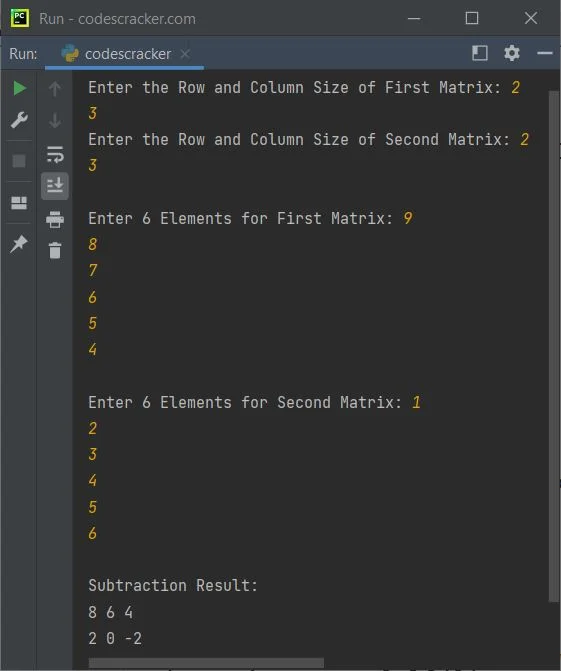
Same Program in Other Languages« Previous Program Next Program » Practice Quizzes
Test your programming and computer science knowledge with interactive MCQs and topic-based quizzes. Popular Topics
Explore the most popular programming and computer science tutorials on CodesCracker. |
| You are visitor 01402503 — GeezerVison does not store the pages you look up. Best viewed with Netscape Navigator 4.7 or Internet Explorer 6 at 800×600. No cookies required. |