GeezerVisonThe World Wide Web, restored to 800 pixels of glory. |
| Home|About|Gaming cabinet|Archives|How it works|Starter sites |
GeezerVison is showing codescracker.com — Python return Keyword/Statement
Python return Keyword/Statementreturn values in python 50% 590 return value in python 50% 590 return python 50% 5400 return function python 50% 3600 python tutorial pdf 10% 590 python return function 50% 3600 python return 48% 5400 python programming pdf 10% 720 python programming cheat sheet pdf 25% 20 python practice 20% 2900 python pdf 10% 1600 python how to program pdf 10% 720 python functions return 50% 3600 python functions practice problems 28% 20 python functions practice 30% 90The return keyword in Python is used when we need to exit from a function with or without a returning value. For example: def codes(): print("First 'print()' inside 'codes()' function") return print("Second 'print()' inside 'codes()' function") def cracker(): return 10 def codescracker(a, b): return a+b codes() x = cracker() print(x) x = codescracker(10, 50) print(x) The output is: First 'print()' inside 'codes()' function 10 60 In above program, the following statement: print("Second 'print()' inside 'codes()' function") is not executed, because just before this statement, a return statement or keyword is used. Therefore the program flow exists from this function. Note - After the return statement, remaining statement(s) will be not executed, if available, inside the same function. Python return Keyword or Statement ExampleThe program given below is an example of return statement: def add(x, y): return x+y def square(x): return x*x def great(x, y): if x>y: return x else: return y print("1. Add Two Numbers") print("2. Find Square of a Number") print("3. Find Greatest of Two Numbers") print("\nEnter Your Choice (1-3): ", end="") choice = int(input()) if choice == 1 or choice == 3: print("\nEnter any two numbers: ", end="") a = int(input()) b = int(input()) if choice == 1: print("\nResult =", add(a, b)) elif choice == 2: print("\nEnter a Number: ", end="") num = int(input()) print("\nResult =", square(num)) elif choice == 3: print("\nGreatest =", great(a, b)) else: print("\nInvalid Choice!") The snapshot given below shows the sample run, with user input 3 as choice, 10 and 20 as two numbers: 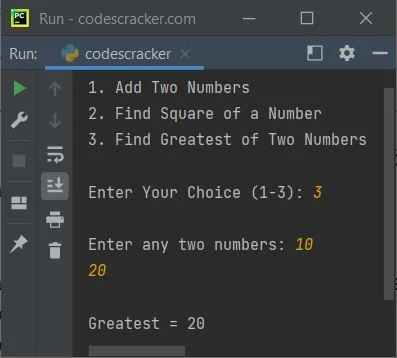
« Previous Tutorial Next Tutorial » Practice Quizzes
Test your programming and computer science knowledge with interactive MCQs and topic-based quizzes. Popular Topics
Explore the most popular programming and computer science tutorials on CodesCracker. |
| You are visitor 01402503 — GeezerVison does not store the pages you look up. Best viewed with Netscape Navigator 4.7 or Internet Explorer 6 at 800×600. No cookies required. |