GeezerVisonThe World Wide Web, restored to 800 pixels of glory. |
| Home|About|Gaming cabinet|Archives|How it works|Starter sites |
GeezerVison is showing www.tutorialspoint.com — Java - Thread Life Cycle 
Selected Reading
Java - Thread Life CycleLife Cycle of a Thread in JavaThe life cycle of a thread in Java refers to the various states of a thread goes through. For example, a thread is born, started, runs, and then dies. Thread class defines the life cycle and various states of a thread. Flow Chart of Java Thread Life CycleThe following diagram shows the complete life cycle of a thread. 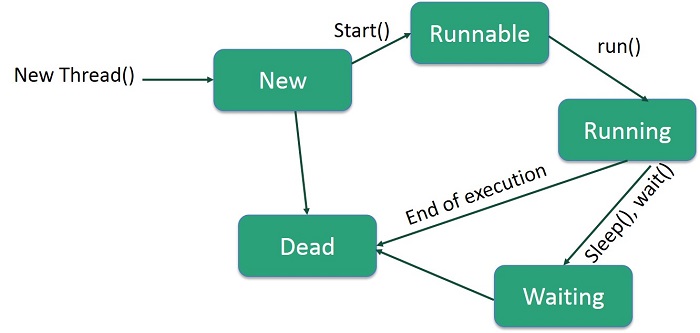
States of a Thread Life Cycle in JavaFollowing are the stages of the life cycle −
Java Example for Demonstrating Thread StatesIn this example, we're creating two threads by extending the Thread class. We're printing each state of the thread. When a thread object is created, its state is NEW; when start() method is called, state is START; when run() method is called, state is RUNNING; When a thread finished the processing the run() method, it went to DEAD state. package com.tutorialspoint;
class ThreadDemo extends Thread {
private Thread t;
private String threadName;
ThreadDemo( String name) {
threadName = name;
System.out.println("Thread: " + threadName + ", " + "State: New");
}
public void run() {
System.out.println("Thread: " + threadName + ", " + "State: Running");
for(int i = 4; i > 0; i--) {
System.out.println("Thread: " + threadName + ", " + i);
}
System.out.println("Thread: " + threadName + ", " + "State: Dead");
}
public void start () {
System.out.println("Thread: " + threadName + ", " + "State: Start");
if (t == null) {
t = new Thread (this, threadName);
t.start ();
}
}
}
public class TestThread {
public static void main(String args[]) {
ThreadDemo thread1 = new ThreadDemo( "Thread-1");
ThreadDemo thread2 = new ThreadDemo( "Thread-2");
thread1.start();
thread2.start();
}
}
OutputThread: Thread-1, State: New Thread: Thread-2, State: New Thread: Thread-1, State: Start Thread: Thread-2, State: Start Thread: Thread-1, State: Running Thread: Thread-2, State: Running Thread: Thread-2, 4 Thread: Thread-2, 3 Thread: Thread-2, 2 Thread: Thread-2, 1 Thread: Thread-2, State: Dead Thread: Thread-1, 4 Thread: Thread-1, 3 Thread: Thread-1, 2 Thread: Thread-1, 1 Thread: Thread-1, State: Dead More Examples on Thread Life Cycle & StatesExample 1In this example,we're using sleep() method to introduce some delay in processing and to show case the parallel processing using threads. We're creating two threads by extending the Thread class. We're printing each state of the thread. When a thread object is created, its state is NEW; when start() method is called, state is START; when run() method is called, state is RUNNING; in case sleep() is called, then thread goes to WAITING state; When a thread finished the processing the run() method, it went to DEAD state. package com.tutorialspoint;
class ThreadDemo extends Thread {
private Thread t;
private String threadName;
ThreadDemo( String name) {
threadName = name;
System.out.println("Thread: " + threadName + ", " + "State: New");
}
public void run() {
System.out.println("Thread: " + threadName + ", " + "State: Running");
try {
for(int i = 4; i > 0; i--) {
System.out.println("Thread: " + threadName + ", " + i);
// Let the thread sleep for a while.
System.out.println("Thread: " + threadName + ", " + "State: Waiting");
Thread.sleep(50);
}
} catch (InterruptedException e) {
System.out.println("Thread " + threadName + " interrupted.");
}
System.out.println("Thread: " + threadName + ", " + "State: Dead");
}
public void start () {
System.out.println("Thread: " + threadName + ", " + "State: Start");
if (t == null) {
t = new Thread (this, threadName);
t.start ();
}
}
}
public class TestThread {
public static void main(String args[]) {
ThreadDemo thread1 = new ThreadDemo( "Thread-1");
ThreadDemo thread2 = new ThreadDemo( "Thread-2");
thread1.start();
thread2.start();
}
}
OutputThread: Thread-1, State: New Thread: Thread-2, State: New Thread: Thread-1, State: Start Thread: Thread-2, State: Start Thread: Thread-1, State: Running Thread: Thread-1, 4 Thread: Thread-1, State: Waiting Thread: Thread-2, State: Running Thread: Thread-2, 4 Thread: Thread-2, State: Waiting Thread: Thread-1, 3 Thread: Thread-2, 3 Thread: Thread-2, State: Waiting Thread: Thread-1, State: Waiting Thread: Thread-2, 2 Thread: Thread-1, 2 Thread: Thread-1, State: Waiting Thread: Thread-2, State: Waiting Thread: Thread-2, 1 Thread: Thread-2, State: Waiting Thread: Thread-1, 1 Thread: Thread-1, State: Waiting Thread: Thread-2, State: Dead Thread: Thread-1, State: Dead Example 2In this example, we're creating two threads by implementing the Runnable class. We're printing each state of the thread. When a thread object is created, its state is NEW; when start() method is called, state is START; when run() method is called, state is RUNNING; in case sleep() is called, then thread goes to WAITING state; When a thread finished the processing the run() method, it went to DEAD state. package com.tutorialspoint;
class ThreadDemo implements Runnable {
private Thread t;
private String threadName;
ThreadDemo( String name) {
threadName = name;
System.out.println("Thread: " + threadName + ", " + "State: New");
}
public void run() {
System.out.println("Thread: " + threadName + ", " + "State: Running");
try {
for(int i = 4; i > 0; i--) {
System.out.println("Thread: " + threadName + ", " + i);
// Let the thread sleep for a while.
System.out.println("Thread: " + threadName + ", " + "State: Waiting");
Thread.sleep(50);
}
} catch (InterruptedException e) {
System.out.println("Thread " + threadName + " interrupted.");
}
System.out.println("Thread: " + threadName + ", " + "State: Dead");
}
public void start () {
System.out.println("Thread: " + threadName + ", " + "State: Start");
if (t == null) {
t = new Thread (this, threadName);
t.start ();
}
}
}
public class TestThread {
public static void main(String args[]) {
ThreadDemo thread1 = new ThreadDemo( "Thread-1");
ThreadDemo thread2 = new ThreadDemo( "Thread-2");
thread1.start();
thread2.start();
}
}
OutputThread: Thread-1, State: New Thread: Thread-2, State: New Thread: Thread-1, State: Start Thread: Thread-2, State: Start Thread: Thread-1, State: Running Thread: Thread-1, 4 Thread: Thread-1, State: Waiting Thread: Thread-2, State: Running Thread: Thread-2, 4 Thread: Thread-2, State: Waiting Thread: Thread-1, 3 Thread: Thread-2, 3 Thread: Thread-2, State: Waiting Thread: Thread-1, State: Waiting Thread: Thread-2, 2 Thread: Thread-1, 2 Thread: Thread-1, State: Waiting Thread: Thread-2, State: Waiting Thread: Thread-2, 1 Thread: Thread-2, State: Waiting Thread: Thread-1, 1 Thread: Thread-1, State: Waiting Thread: Thread-2, State: Dead Thread: Thread-1, State: Dead 
Advertisements
|
| You are visitor 01402503 — GeezerVison does not store the pages you look up. Best viewed with Netscape Navigator 4.7 or Internet Explorer 6 at 800×600. No cookies required. |